Dan Waber and Jenny Hill are making it happen in so many ways: they’re making a living creatively.
I first met Dan in 2014 when he agreed to be interviewed for LancasterOnline about his hypertext poetry in advance of a performance.
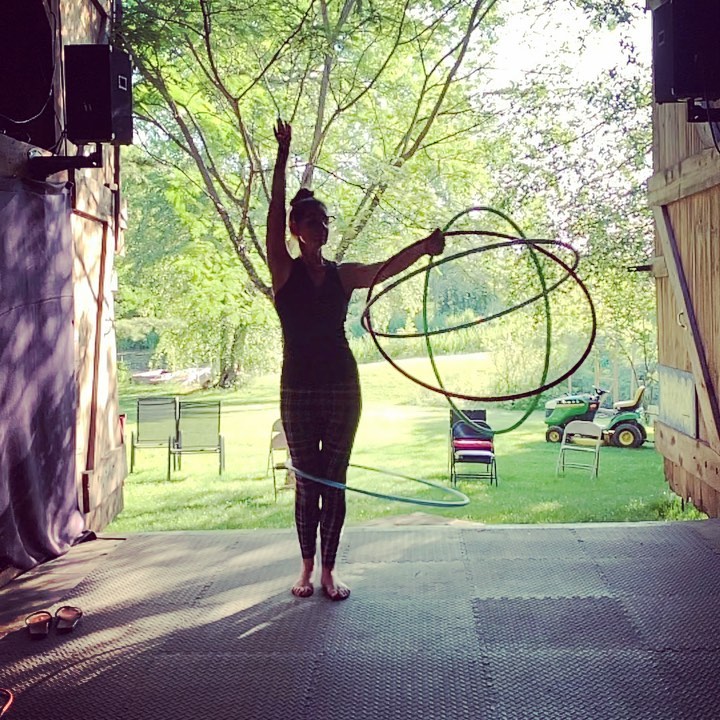
Jenny, also a poet, has a website actsofjennius.com where you can learn about her work as a writer, arts educator, and circus performer and clown.
Just as Dan and Jenny bring art to the people, they bring the people homegrown tomatoes and tinned fish via their business Rainbow Tomatoes Garden (you can purchase food items, elegant stationary and more at their retail location and through their online store).
The couple have a performance and workshop venue on their Montgomery County farm called the Wunderbarn. Last year’s roster of events included Vaudeville Storytimes, a papermaking and collage workshop, musical and theatrical performances, a fall arts festival, and much more. They offer creative workshops, and Artist Playdates on the fourth Sunday of each month. They are gearing up for this season with more Vaudeville Storytimes and Farm Poetry Tours with the hilarious character Tom Mato (played by Jenny).
Dan and Jenny are an inspiring couple of people to me and to many others. I am just in awe of them. I want to find out what makes them tick so I can be them! Hence this interview. They were kind enough to answer my questions in September 2022. Please enjoy 🙂
- Where do your ideas come from?
Dan: In “Dreams with Sharp Teeth”, the Harlan Ellison documentary, he quips:
People ask me where I get my ideas. I always tell them, “Schenectady.” They look at me with confusion and I say, “Yeah, there’s this ‘idea service’ in Schenectady and every week like clockwork they send me a fresh six-pack of ideas for 25 bucks.” Every time I say that at a college lecture there’s always some schmuck who comes up to me and wants the address of the service.
I’ve always been partial to the notion that inspiration is in the dust kicked up by work. I do things and I get ideas. When I started growing my own food I largely stopped creating text-based artifacts because it was a kind of doing that put me in a constant state of epiphany.
Jenny: Paying close attention to things, including dreams, and then exploring those things that make me curious.
- What inspires you the most?
Dan: I’m not sure I’m inspired as much as I’m irritated; most of the things I’ve created are the result of me being irritated that the world lacked the thing I made, so I made it. But I think often about how the word inspire means to breathe in, inspiration is the partner to exhalation. Breathing inspires me the most, being alive is a fundamentally creative act, life is that which resists entropy.
Jenny: The way things move, specifically things in the natural world. Emotions. When you give things your full attention, you gain much.
- Do you feel competitive with other artists? If so, who?
Dan: Not only do I not feel competitive with other artists, I don’t think art, of any kind, should be viewed as a competition. It is one of the fundamental misunderstandings of this era that we constantly confuse the qualitative and the quantitative. Bigger isn’t better, genius is particular and unique, and all attempts to rank things that are best understood in qualitative terms are failures in thinking.
Jenny: No. I do feel competitive with myself sometimes, because I am impatient with my own abilities. I don’t believe that art is or ever should be a competitive sport. Competition is for athletes.
- How does art play into your relationships with each other and with friends and family members?
Dan: It is interwoven into everything we do as a family, we are all creators and exist in a constant state of creating. We sometimes even collaborate, but probably not as much as others might imagine we would. We are definitely sounding boards for each other, we bounce things around, we offer feedback, we encourage, we point out where we think things may be clanking. In our working we are kicking up that dust of inspiration into clouds that linger and it doesn’t really matter who walks through the cloud, breathing it in. We grow and change as people and as creators, and that can sometimes cause tensions, as in any situation where more than one person is trying to do something as complicated as balance on a log in a river–which is to say, live in today’s world.
Jenny: We spend a lot of time together, especially since moving here and starting the farm/farmstand, theatre and bakery. We are Team Tomato Sardine Theatre Muffin! Much of what we do is related, and interconnected, but right now I am in my writing room answering these questions after having finished up a series of lesson plans, Dan is upstairs in his office handling orders, and Helen is in the kitchen fulfilling a large bakery order. We just had lunch which was a soup I made, and we talked about how we felt about a business meeting yesterday – very specifically how we all felt about the phrase a mentor in the meeting used – “hitting a speedbump.” We each pulled at that phrase like it was taffy to get at what it meant to each of us. We laughed at how impossible it is to predict the future. Then we ate more soup. I consider all of that an act of shared creativity. I feel so lucky to have moments like this every single day. Words, soup, ideas, laughter? It gets no better than that.
- Who are the artists that inspire you the most, and why/how do they inspire you?
Dan: “Most” is a quantitative term for a process which is fundamentally qualitative, so I bristle at answering in those terms. I would say that Jenny is the artist who inspires me the most often, the most deeply, and in the directions most likely to make me a better person and the world a better place. The work of Pina Bausch continually stuns me. I love the films of Terrance Malick, Symphony No. 3 by Henryk Górecki, more books than there is time or space to list.
Jenny: I’m going to batch answer these three questions since they are all related. My parents were my biggest influences. I was fortunate to have parents who encouraged “noodling around.” Noodling is goofing around, testing out ideas, seeing what works and what doesn’t. So my sister and I were often left to our own devices to entertain ourselves. There were lots of circuses, hair salons, restaurants (where I served my parents food in my bedroom), variety shows, artwork, science experiments, radio shows. You name it, we probably at least tried it. My parents WERE and ARE some of my biggest influences in art, life, as a kid, and as an adult. They are gone now physically, but they are very much present in every single thing I do. I really love being around people who think differently than I do, who have intelligences other than my own, and who are curious about the world. Dan is an influence. Helen. My sister. Many of my friends who I perform with are direct influences on me and my work, because they make me see things differently. Artists who have inspired me and continue to inspire are those who make me laugh, who make me think, who make me want to move, to be better, to help others, to encourage. And that’s a really long list which includes my husband (whose love of seeds and farming inspires me to be better with patience), and my daughter (who also models patience and persistence and a deep self-awareness in her life and art). But some names who spring to mind as I write this are Carol Burnett, Anna Swir, Slava Polunin, Claire Porter, Twyla Tharp, E.B. White, Nora Ephron, Pablo Neruda (I’m thinking of his Book of Questions), David Sedaris, Richard Grunn …
- Who are your biggest influences?
- Who were your biggest influences, in art and/or life, as a kid or in young adulthood?
Dan: These seem to be largely the same question, so I will answer them together. Again, I find the idea of “biggest” to be an attempt to talk in quantitative terms about something that is best understood in qualitative terms. At our best we are capable of being greater than the sum of our influences, so it behooves us all to make that sum as great is it can possibly be. By which I mean we should seek to be influenced by as many people and places and things as we possibly can. I can identify thousands of small influences, but struggle to think of any that I’d call big, bigger, or biggest. I am being influenced by these questions, even as I type. If forced to identify a specific “biggest influence” I would have to say my mother. Pretty much everything I do and have done since I became self-aware has some component of hoping she’d be proud of what I made.
- What’s the most important thing that’s ever happened to you?
Dan: Being born. Meeting Jenny. Planting seeds.
Jenny: “Important” covers a lot of ground. I think of important things as teaching moments, or shift in perspective, and my life is pretty much built on them. Isn’t every day an important day? The day before yesterday, high on new light after we removed a fence from around the house, I went out to cut back all the trumpet vine that had silently grown along the fence. Handsaw in my left hand, boots on my feet, heady with power, I started stepping on the trunk of the plant to crack it, and boom — I went down, hard. I fell on my knees, teeth clattering, spine sparkling like a party favor on New Years Eve. I thanked my guardian angels out loud for keeping the saw blade from meeting my face. It was just a few inches away.
Humility! I could have fallen on my ass, but I fell on my knees. Some words of thanks were not just necessary but automatic. And now I’m taking care to put tools down before getting rowdy with plants.
I gave birth to Helen and that was important. I no longer thought in “I” but “us.” Reading my first poem in public made me realize I wanted to be better at it (both writing poems and sharing them), so I kept pursuing that. Getting onstage and doing burlesque many years later was an important moment, too, not unlike writing and performing a poem. Forgetting where I was in a clowning scene – was I audience or performer – and being TOLD I performed the scene really gave me a moment of pause, so I’d consider that important. I’d left Jennifer Hill in the audience, while her clown took the stage. Of course meeting Dan and marrying him, but first I think the most important early moment with him was when he carried me piggyback across a street and a bus driver waved at us. Caring for my mother at the end of her life. Painful, beautiful, and important moments, each one of them.
- What’s your favorite art medium right now?
Dan: I am always most drawn to things that involve text and words and how meaning is made.
Jenny: I pick no favorites. I love them all, and they all connect in one way or another. Poetry informs clowning, circus arts informs making soup, and vice versa.
- Out of all that’s going on in the world right now, what troubles you the most or makes you feel pessimistic?
Dan: Lack of empathy, and all the ways digital media exploits and encourages it.
Jenny: Greed. Money.
- Out of all that’s going on in the world right now, what makes you feel the most optimistic?
Dan: Children. They are the greatest resource our continued survival as a species has on its side. Their minds are still adaptable and able to create their way out of any problems.
Jenny: Kids and the elderly. We should listen to them more. Their stories are the best stories.
- What makes you happy?
Dan: Seedlings. The sound of Jenny and Helen laughing in another room. Enthusiasm. Grace. Ducks.
Jenny: See all my comments above (and some of Dan’s!). All of it with the exception of money and greed. Ducks are hilarious, Dan! Yes, the way ducks move.
- Do you believe in magic? If so, what is magic?
Dan: I do not believe in magic, or miracles.
Jenny: YES! I don’t know what it is. I don’t think I’ll ever get to know what it is, and that’s ok. That’s the nature of magic. Not knowing. I’m looking forward to the conversation Dan and I will have about magic later.
- What are your short-term goals?
Dan: I guess that would depend on the definition of short-term. I have goals for today, for the week, for the month, for the year. I’m very goal-driven. But most of my goals are too personal to share publicly. In broad, general terms they involve doing better (continuous incremental improvement) and being a better person.
Jenny: To NOT eat the extra cupcake in the kitchen.
- What are your long-term goals?
Dan: To live forever. And if I can’t live forever, to live my life in such a way that the worms are glad I lived.
Jenny: To eat the extra cupcake in the kitchen. Please tell me there’s one in there.
 Fountain of dreams